A prognostic sphere is, at its simplest, a device which predicts whether a patient will live or die based (a) on the patient’s name and (b) on astrology. This is its original and most widely attested function. The earliest is witnessed in a 4th century Greco-Egyptian papyri, where it appears as the Sphere of Democritus (PGM XII.351),1 but perhaps of a much earlier provenance. It carries many names and attributions, often connected to quasi-mythological figures like Pythagorus, Apuleius, or Petosiris.
The basic function is as follows: the sphere, no matter its shape in reality, is seperated roughly into a lower and an upper half. Each contains a list of numbers. The patient’s name, the date they fell ill, and perhaps constants associated with the ruling planet or other variables are summed and divided by 30 (or 29, or other integers according to specialized uses.) The remainder is located on the sphere: broadly, upper half means “life” and lower half means “death”. Greek is trivial to convert to a number because of the ancient convention of isopsephy; later Latin versions provided opaque ciphers to do so.2
| Life 1, 10, 19, 2, 11, 20, 3, 13, 23, 4, 14, 25, 7, 16, 26, 9, 17, 27 |
| Death 5, 15, 22, 6, 18, 28, 8, 21, 29, 12, 24, 30 |
Prognostic spheres were used well into the 19th century, and even into the 20th albeit in a very reduced form.3 Thus, these were in continuous use for over 1,500 years at the least. As such they have shown a huge amount of variation in their application and presentation. These are two (relatively early) examples with tasteful coloring, from MS NAL 1616:
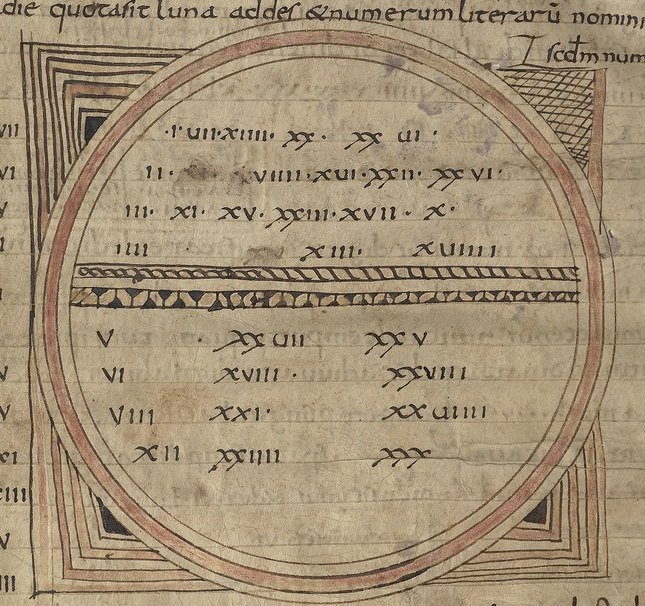
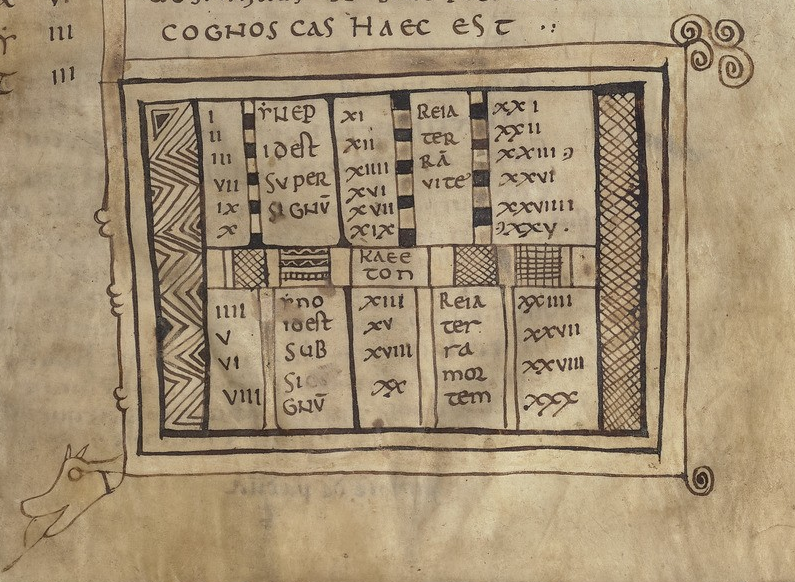
The circular diagram on 7v is a redaction of the Sphere of Apuleius or Pythagoras, titled in the manuscript as “the Sphere of Pythagoras that Apuleius described”. The rectangular design, with the lovely dragon ornament, is a redaction of the Tetragonus subiectus, which unfortunately fell out of popularity by the Renaissance. Another interesting variation are those which use Jesus4 rather than (or in association with) a sphere:
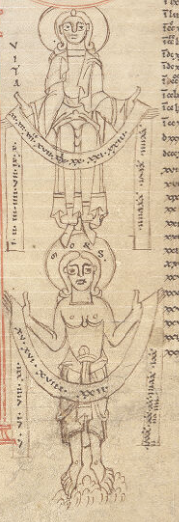
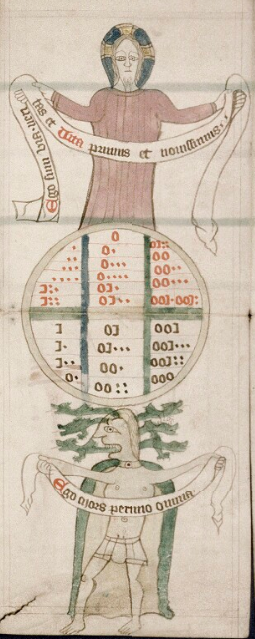
To make this point explicit: I believe the spiritual architecture — the visual and spatial motifs used to organize life and death — can tell us a fair bit about the cosmology of those who produced and used these spheres. This is obvious (and literal) enough in the following witness, in which the sphere becomes an astrolabe5:
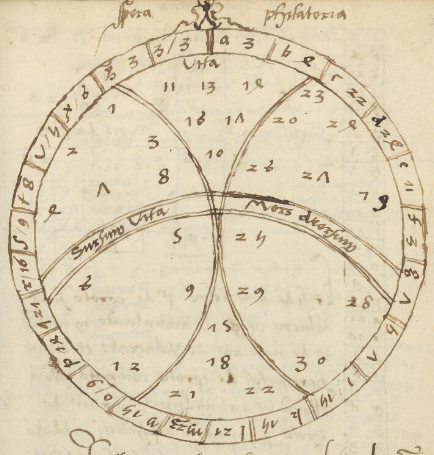
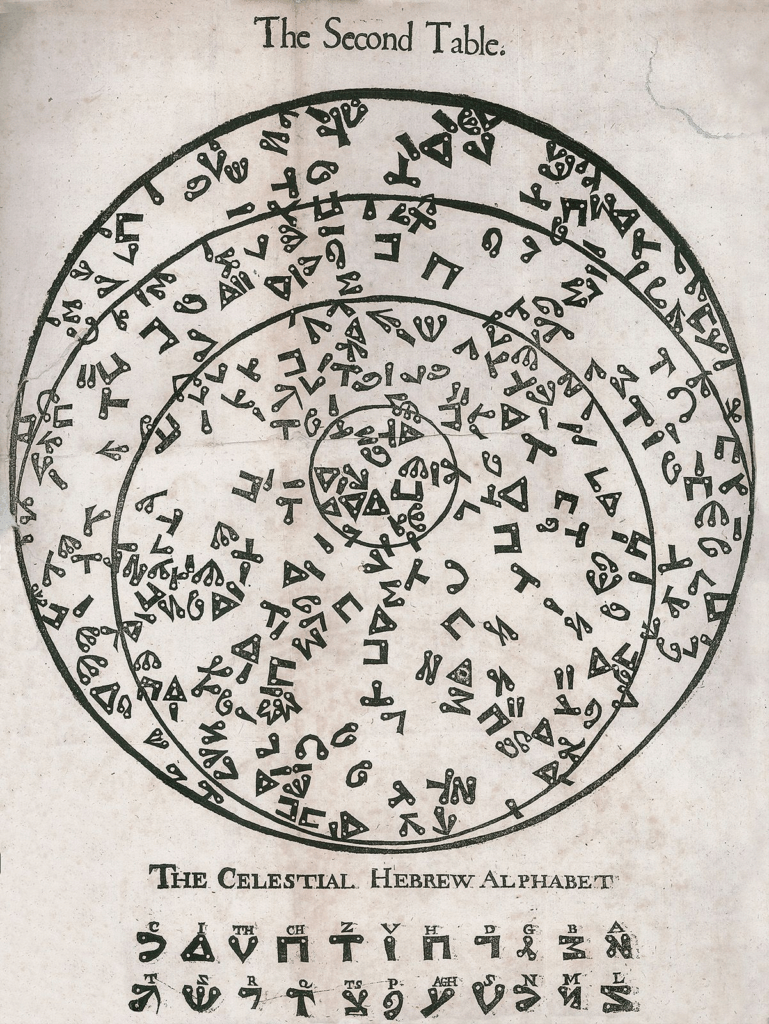
Interestingly, the influence may not have been one-way; Chaucer’s astrolabe exhibits a ring of Latin letters on the outer circumference, which may have been inspired by prognostic spheres.6 This celestial configuration of numbers — the spirit of the letters, according to the medieval ʿIlm al-Ḥurūf 7 — brings to mind the celestial alphabet inscribed in the firmament, as depicted by the Christian Cabalist Jacques Gaffarel.
Blah, blah, blah. I’m tired of writing this article no one will read. In short, the prognostic sphere is a page in the world-text; Vigenère’s cipher of nature.8 How this page is depicted and interpreted differs according to time and place. #ItsNorte
Manuscripts
- Paris, Bibliothèque nationale de France, NAL 1616
- London, British Library, Harley 3667
- Oxford, Bodleian Library, Rawl. D. 939
- London, Wellcome Library, MS.364
Footnotes
- Liuzza, Roy Michael. “The sphere of life and death: time, medicine, and the visual imagination.” Latin Learning and English Lore: Studies in Anglo-Saxon Literature for Michael Lapidge 2 (2005): 28-52. ↩︎
- Juste, David. “Non-transferable knowledge: Arabic and Hebrew onomancy into Latin.” Annals of Science 68.4 (2011): 517-529. ↩︎
- For example, in Rosa Baughan’s Influence of the Stars, an astrological manual (among other things) published first in 1889 and in print for decades after. ↩︎
- Notice that the example in MS Harley 3667 uses Jesus twice: in his glory as a symbol of life, and in his passion as a symbol of death. MS Rawl. D. 939, on the other hand, uses the Devil to symbolize death! ↩︎
- This is identifiable by the kursi or throne at the top of the diagram, where the astrolabe is traditionally suspended. This is not the first time a kursi has been used in this manner: the “geomantic tablet” in the British Museum exhibits one as well. Of course, neither of these items would ever need to be suspended. ↩︎
- Eagleton, Catherine. “‘Chaucer’s own astrolabe’: text, image and object.” Studies in History and Philosophy of Science Part A 38.2 (2007): 303-326. ↩︎
- Lory, Pierre. La science des lettres en Islam. Dervy, 2004. ↩︎
- See his Traicté des chiffres. ↩︎
Leave a Reply